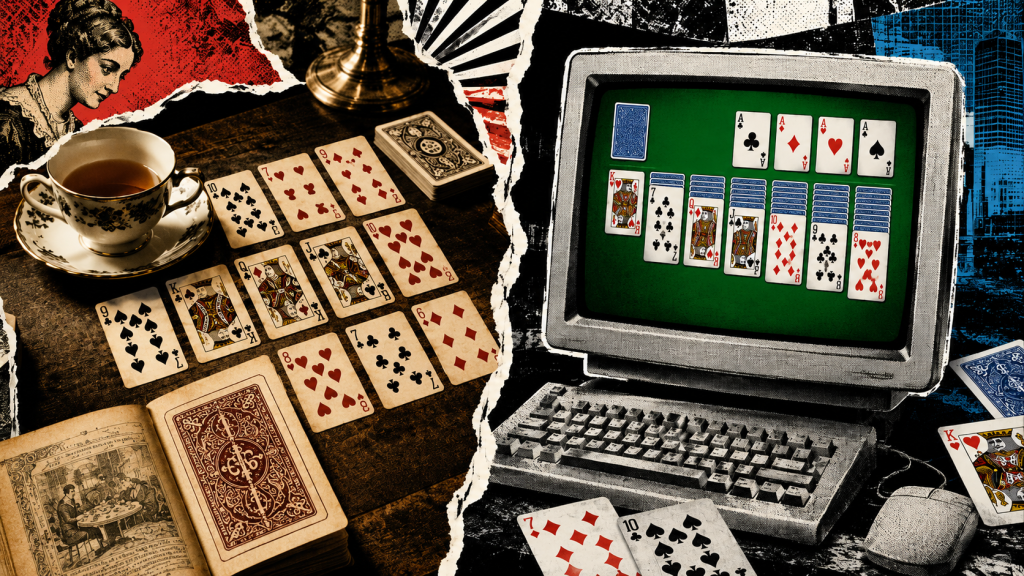
Patience sounds like something your grandmother played with a quiet cup of tea. Solitaire sounds like a green computer table and one more deal before bed. The games overlap so much that the words often trade places, but they carry different baggage.
Patience is the older card game name in English sources. It points to the act of waiting out a stubborn layout and making careful little choices. Solitaire grew into the common North American word, especially after Solitaire usually meant Klondike on home and office computers.
Both words can be correct. The useful question is where the reader is standing.
I think of Patience as the bookshelf word and Solitaire as the desk word. One smells faintly of rule pamphlets. The other has the glow of a monitor after midnight.
Patience Belongs To The Card Shelf
When older British books say Patience, they usually mean a card game played alone or mostly alone. You deal a layout, follow a rule system, and try to bring order out of a deck that seems personally offended by your plans.
That word also catches the mood of the games. A good Patience deal asks for restraint. You wait before filling a space. You hold a playable card because moving it now might trap the card underneath. You stare at a red seven for a weird amount of time.
The name fits. These games reward calm, but they also test the exact kind of calm that vanishes when the only black eight is buried three cards deep.
Solitaire Got Bigger And Messier
Solitaire became the everyday North American umbrella. It can mean card solitaire as a genre. It can also mean Klondike by habit. Outside cards, the same word can point to peg solitaire or other solo puzzles, which is where the confusion starts to slouch into the room.
That is why card solitaire is the clean phrase when precision matters. It keeps the conversation on decks, tableaus, foundations, stocks, and waste piles. It also leaves room for games that feel nothing like Klondike.
Pyramid belongs here. So do Spider, FreeCell, Beleaguered Castle, and a long parade of old Patience names that sound like they came from a dusty rule book with opinions.
The wider word also matters for strategy. Klondike advice about foundations means little in Pyramid. FreeCell has open information and spare cells. Spider builds full suit runs inside the tableau. One family name covers a lot of strange relatives.
Let The Table Choose The Word
In everyday play, Solitaire is the word people reach for first. It is quick, familiar, and a little sloppy in the way useful words often are.
Patience has a different feel. It belongs to older rule books, British tables, and games where the name sounds like part of the ritual. You can almost hear the cards being squared up before the deal.
Card solitaire is the tidy phrase. It helps when the conversation needs room for Klondike, Pyramid, Spider, FreeCell, and all the odd little relatives that refuse to play the same way.
I like that the words overlap. It makes the whole family feel lived in. A game can have a formal name, a casual name, and the name people use when they are halfway through a bad deal and muttering at a black eight.

I grew up playing card games with my family. During the summers, we spent time at our little beach shack in Murrells Inlet, South Carolina. It was my grandparents’ place, and they were old school in the best way. Not much TV, no video game consoles, and a lot of time around a table with a deck of cards. My grandfather taught me how to play solitaire, and I have been hooked ever since!