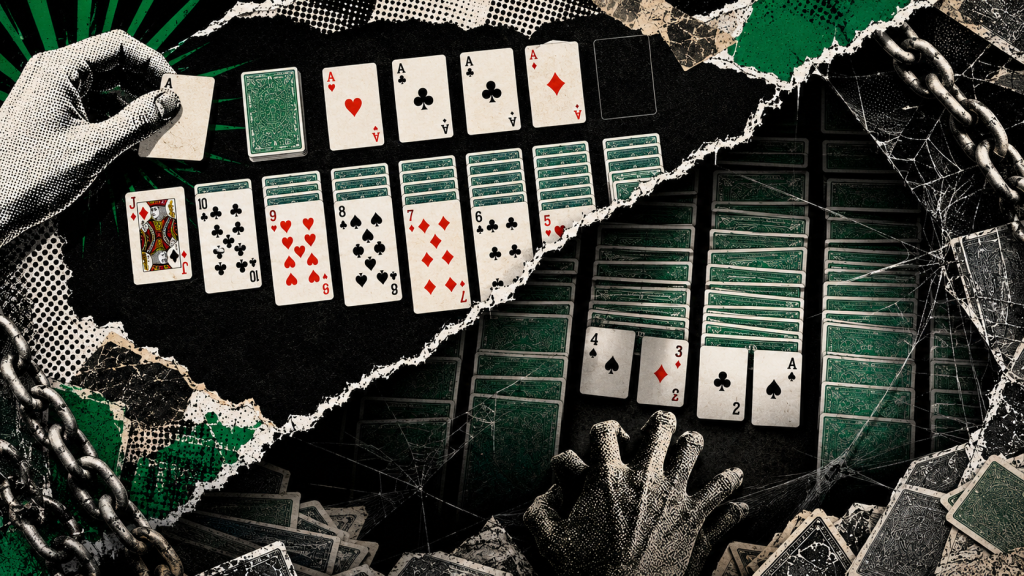
Klondike has the manners of an easy game. Aces go up. Tableau cards go down in alternating colors. Kings get empty spaces. The first few moves often feel so obvious that you start to trust the deal.
Then one facedown card stays buried under a long pile, and the whole table gets tight.
That is Klondike’s trick. It gives you enough information to feel responsible and hides enough information to make responsibility awkward.
Hidden Cards Make Good Moves Look Suspicious
A move can be legal, useful, and still wrong for this deal. Turning over a buried card might matter more than building a pretty sequence. Holding a red six might keep a black five useful later. The correct move may depend on a card you cannot see.
That hidden-card pressure is the reason regular Klondike resists a single clean win rate. Studies and rule books report different numbers because the rules differ, the players differ, and the amount of known information differs. Draw one and draw three live in different neighborhoods.
The exact probability for regular best-play Klondike remains slippery because the player has to act without seeing the whole pack. The usual Klondike layout looks familiar, but familiarity can hide a nasty little math problem.
This is the part that makes losses feel personal. You remember the move you made. You forget the three unknown cards that shaped the trap. Klondike lets the player feel guilty for guessing inside a locked room.
Thoughtful Klondike Changes The Room
Thoughtful Klondike shows where every card is. Same broad game shape, different mental weather. When all card locations are known, the deal becomes closer to a planning problem. You can test lines. You can see whether a move opens a real path or just feels helpful.
That version helps researchers talk about an upper limit, but it says something about normal play too. Most losses in Klondike feel like failures of attention. Many are failures of information. The deck kept a secret and charged you for guessing.
This is why old names and old categories matter. Patience as a word catches the mood better than Solitaire sometimes. The game asks you to wait with incomplete facts.
The known-card version also exposes how many ordinary habits are just hunches. Move the six now. Leave the seven. Burn through the stock. With every card visible, those hunches can be tested. In regular play, they just sit there looking confident.
The Game Punishes Tidy Habits
Automatic moves can cause trouble. Clearing a tableau card too fast can remove a color you needed for packing. Filling an empty column with the first king you see can freeze the board in place. Recycling the stock can look harmless until the waste order locks away the one card you needed.
Klondike punishes tidy habits because the table changes value after every flip. A move that felt sensible ten seconds ago may look silly once the hidden card turns out to be another queen. Of course it is another queen.
A good player develops a little distrust. Empty a pile, but ask what the empty space can actually do. Move to the foundation, but check whether the tableau still needs that rank. Flip from the stock, but remember that the waste order may come back with teeth.
That is also why the Gold Rush origin story feels too cute for the game. Klondike plays less like striking gold and more like digging around a rock you chose badly. Still, you deal again. The next seven columns might behave.

I grew up playing card games with my family. During the summers, we spent time at our little beach shack in Murrells Inlet, South Carolina. It was my grandparents’ place, and they were old school in the best way. Not much TV, no video game consoles, and a lot of time around a table with a deck of cards. My grandfather taught me how to play solitaire, and I have been hooked ever since!