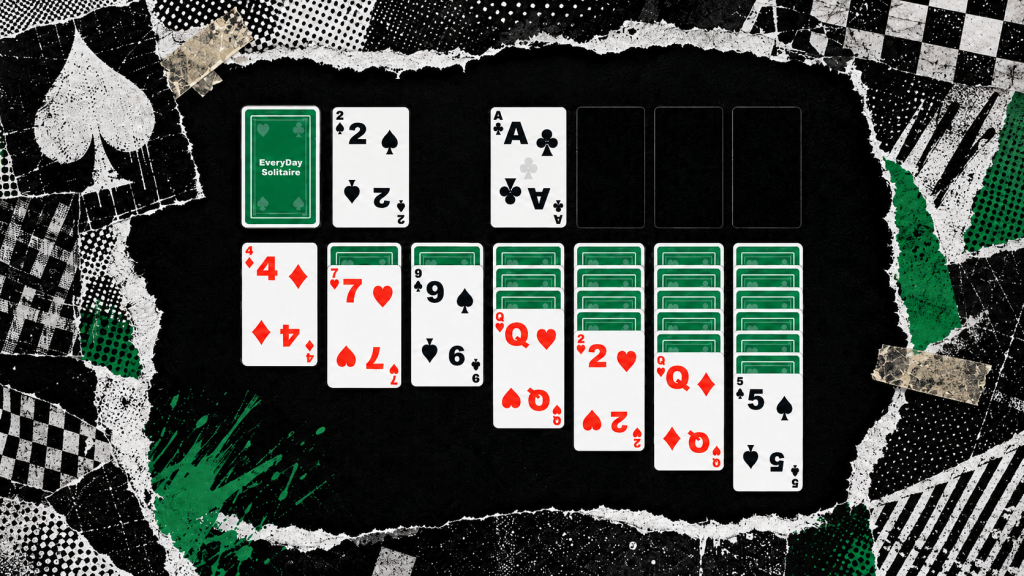
The funniest thing about Solitaire is that the word behaves like a nickname. Say it in North America and most people picture seven columns, a stock pile, a waste pile, and four little foundation spots waiting for aces.
That picture has a real name. Klondike.
Solitaire as a family is much wider. Some games build suits. Some pair cards off the table. Some make you add values until the layout feels like arithmetic with a grudge. Yet Klondike got the plain label on the box. It became the game people meant before they knew they meant a variant.
That habit changes how people talk. A player says they lost at Solitaire, and nobody asks whether the game was Flower Garden or Beleaguered Castle. The brain fills in Klondike before the sentence has cooled down.
Klondike Had The Right Kind Of Trouble
Klondike wins the popularity fight because it looks generous. You get seven tableau piles, a steady stream from the stock, and enough face-up cards to believe you are in control. Then the hidden cards under the long piles start whispering rude things.
That mix is important. A game that feels solved after two deals disappears from daily life. A game that feels hopeless after three moves gets folded back into the drawer. Klondike sits in the middle. You can make smart moves, get punished anyway, and still blame that buried black queen with a clean conscience.
The layout also reads well. Even a new player understands the direction quickly. Down in alternating colors on the tableau. Up by suit on the foundations. Kings in empty columns. The rules have table manners, which helps a lot when a game wants to travel.
Software Gave The Name A Louder Voice
Then Windows put Klondike in front of everybody. Microsoft Solitaire arrived with Windows 3.0 in 1990, and it did more than kill a few lunch breaks. It taught a generation that the little green table was Solitaire, full stop.
The computer version also cleaned up the friction. No shuffling. No card corners catching under the seven pile. No awkward reach across the table because the stock is drifting into the coffee mug. The machine handled the fussy parts and left the tiny decisions exposed.
That matters more than nostalgia admits. When a game is one click away for years, the name on the menu becomes the public name. Klondike already had a head start. Windows gave it office lighting and a permanent chair.
It also taught the game through repetition rather than explanation. People learned the shape by clicking. They learned the waste pile by failing to use it. They learned that an empty column wants a king because the screen simply refused everything else.
The Family Kept Moving Around It
Other solitaire games kept their own identities. Spider feels heavier. FreeCell feels like a logic puzzle with better posture. Pyramid has a lean little appetite for pairs that total thirteen. Good games, all of them.
They also came with names that behaved like names. Spider sounds like a specific challenge. FreeCell tells you about those precious holding spaces. Pyramid points to the layout before a card moves. Klondike had that too, but the bigger label kept swallowing it.
Klondike still owns the casual word because it became the shared reference point. People learn other variants by asking how they differ from the seven-column one. That is power. A whole genre turned into a comparison against one familiar layout.
Solitaire can mean many games. At the kitchen table or on a phone screen in North America, it usually means Klondike because Klondike was easy to recognize, hard to quit, and lucky enough to be bundled with the machine everyone already used.

I grew up playing card games with my family. During the summers, we spent time at our little beach shack in Murrells Inlet, South Carolina. It was my grandparents’ place, and they were old school in the best way. Not much TV, no video game consoles, and a lot of time around a table with a deck of cards. My grandfather taught me how to play solitaire, and I have been hooked ever since!